The market has improved, but the economy is mixed.

Markets
At OmniDivitia Wealth Management, we evaluate market conditions using our Active Regime Analysis framework. Rather than relying on headlines or any single economic indicator, the framework evaluates three distinct components:
Current Market State — How investors are behaving today.
Market Trend — Whether longer-term market momentum is strengthening or weakening.
Economic Trend — Whether underlying economic conditions are improving or deteriorating based on both hard and soft economic data.
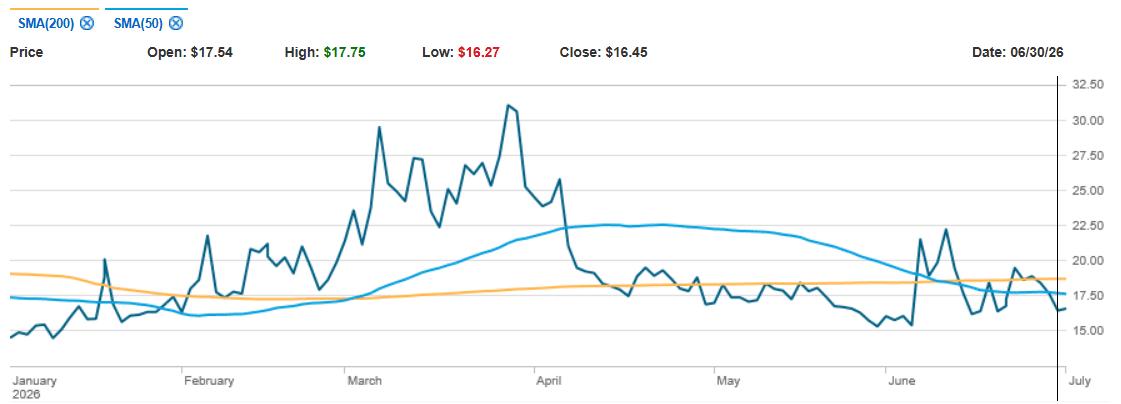
Following the heightened volatility experienced late in the first quarter, investor confidence improved steadily throughout the second quarter. As you can see on this chart of the "VIX", the CBOE Market Volatility Index, volatility is virtually half of what it was at the beginning of the quarter. Strong corporate earnings, continued economic expansion (especially those tied to the AI capital expenditures), and reduced uncertainty surrounding several macroeconomic concerns allowed investors to gradually re-embrace risk. As a result, our Market State improved from Neutral to Bullish.
More importantly, the improvement was not limited to investor sentiment alone. Our Market Trend analysis also shifted to Improving, suggesting that market momentum has broadened beyond a short-term recovery. While volatility has not disappeared, recent price action increasingly reflects improving underlying market participation rather than simply relief from earlier uncertainty. Markets often attempt to anticipate economic conditions based on a number of factors, including forecasted earnings growth. The improving Market Trend suggests investors expect economic growth to continue despite the more measured signals currently being produced by the broader economy.
Economy
While financial markets have become increasingly optimistic, the economic picture remains more balanced.
Our Economic Trend incorporates both hard data, including employment, inflation, industrial production, and corporate earnings, and soft data, such as consumer confidence and business sentiment surveys. Evaluating both perspectives provides a more complete picture of the economy's overall health.
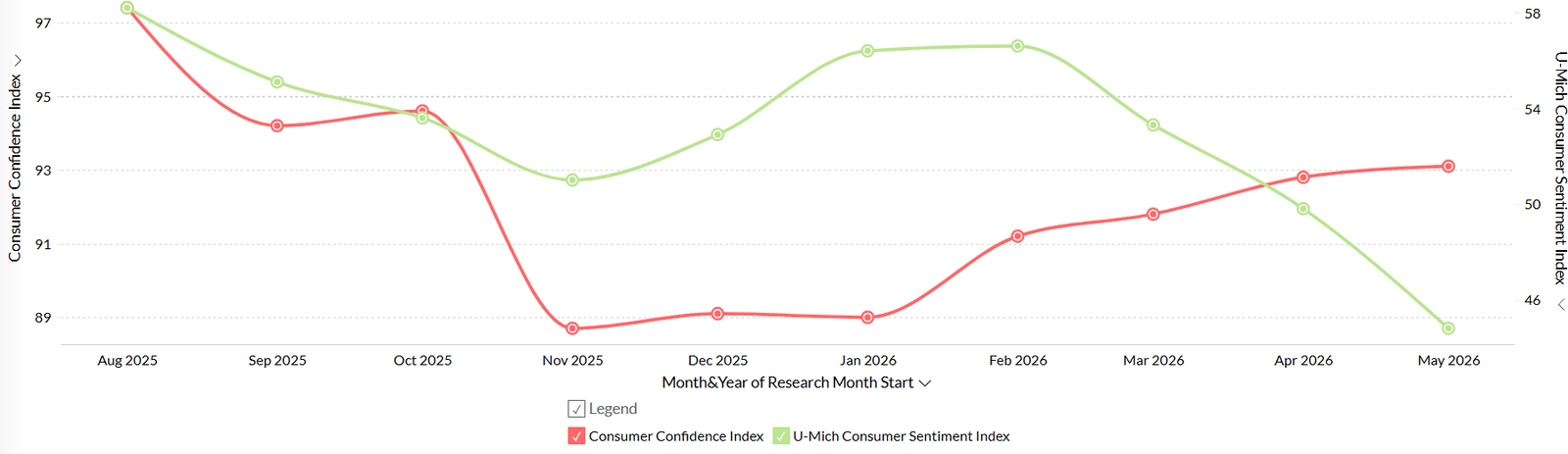
Soft data, however, continues to reflect greater caution. Consumers remain concerned with the labor market, potentially higher borrowing costs and inflation, while many businesses continue to navigate their own concerns (such as slowing demand) as well as elevated policy uncertainty. Note that on the above chart, the Conference Board's Consumer Confidence Index is more focused on the labor market, while the University of Michigan's Index of Consumer Sentiment is more focused on consumers and their views of "pocketbook issues." One could conclude that the downward trend in the University of Michigan's survey is one reason why corporations could be concerned about slowing demand, and how they deal with it. (Can anyone say "A.I."?)
Taken together, these signals continue to support a Mixed Economic Trend.
Conclusion
The second quarter marked a constructive shift in the investment landscape.
Both our Market State and Market Trend improved during the quarter, indicating that investor confidence has strengthened and that longer-term market momentum is beginning to confirm that improvement. At the same time, our Economic Trend remains Mixed, reminding us that economic fundamentals continue to expand but are doing so at a more moderate pace.
This combination represents a healthy reminder that markets and economies do not always move in lockstep. Financial markets frequently anticipate future economic conditions well before those improvements become evident in traditional economic data.
For long-term investors, the current regime supports remaining invested while maintaining realistic expectations. Strong market advances are certainly possible, but elevated valuations and a late-cycle economic backdrop reinforce the importance of diversification, disciplined portfolio management, and focusing on long-term objectives rather than short-term headlines.
- We have gathered this information from sources we deem reliable, but we do not guarantee its accuracy.
- Portions of this content have been generated with the assistance of artificial intelligence (A.I.). This post is for informational purposes only. Please consult your financial advisor for specific guidance